
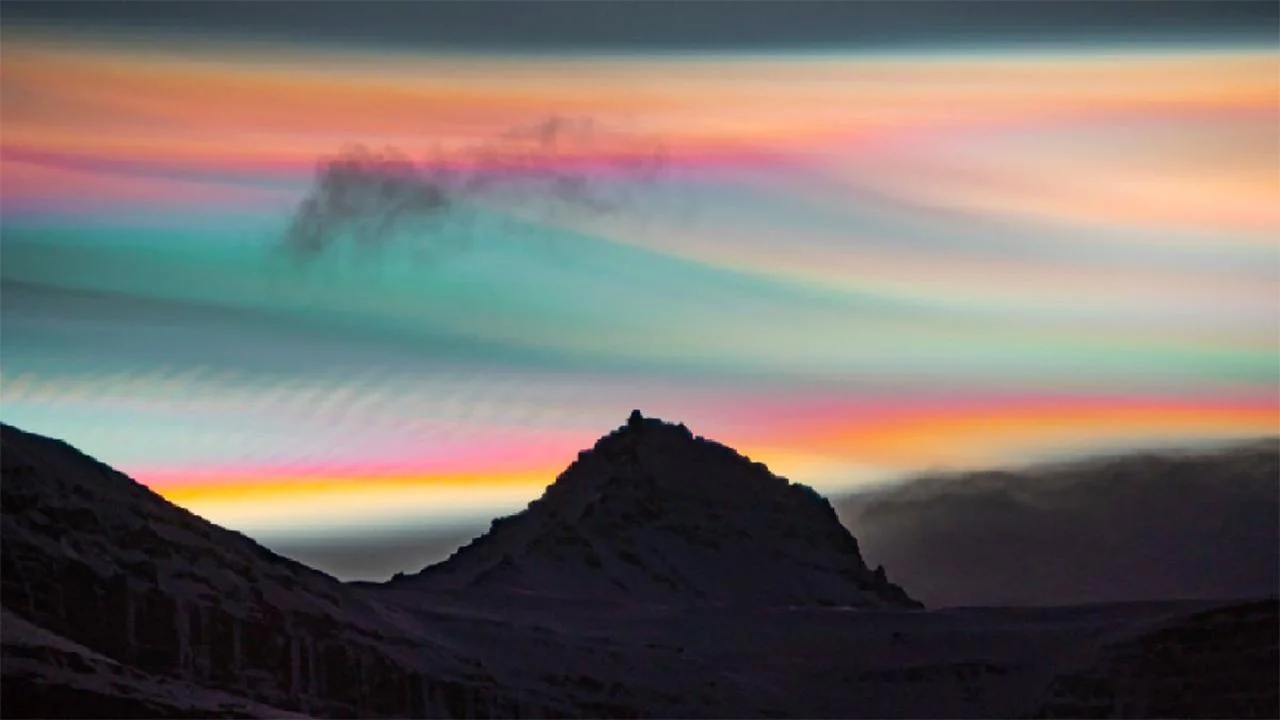
But in late January, a different kind of spectacle stole the spotlight: ultra-rare “rainbow clouds” that shimmered with vibrant hues above the frozen landscape. These brilliant, iridescent displays captivated observers in Iceland, Norway, and Finland, prompting awe-struck reactions and a wave of breathtaking photographs across the internet. Unlike auroras, which are powered by solar particles interacting with Earth's magnetosphere, these rainbow clouds have an entirely different origin.
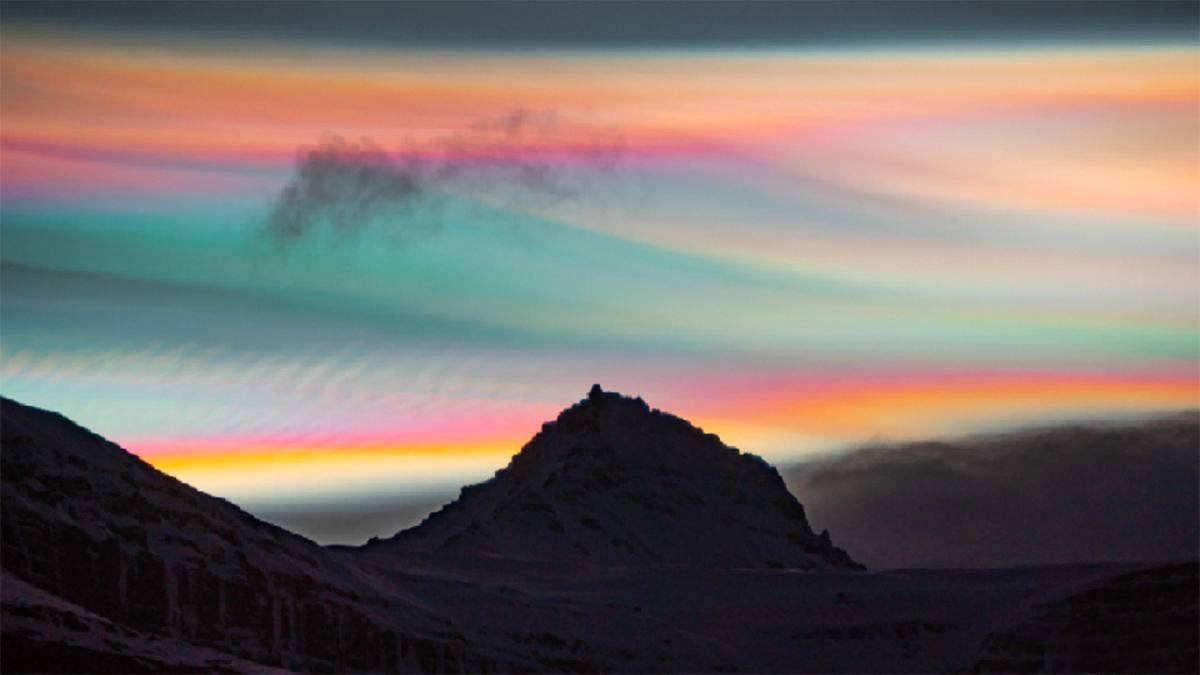
Bright multi-colored clouds shining in the night sky above Mount Jökultindur in Iceland on Jan. 25. (Image credit: Jónína Guðrún Óskarsdóttir)
Known as polar stratospheric clouds (PSCs), they form under some of the coldest temperatures on the planet in a region of the atmosphere normally too dry for clouds to appear at all. The result is a phenomenon so rare and vivid that many people mistake it for the northern lights. Understanding how these clouds form reveals not only a spectacular natural event but also a deeper connection to atmospheric science, ozone layer health, and climate change. This article explores what PSCs are, why they create such dazzling colors, and why they might become more common in the future.
What makes rainbow clouds so rare
Rainbow clouds, or polar stratospheric clouds, form far above the altitude of normal weather systems. While typical clouds develop in the troposphere, PSCs form in the stratosphere, between 9.3 and 15.5 miles above the ground. The stratosphere is usually extremely dry, making cloud formation nearly impossible. For PSCs to appear, temperatures must drop below an extraordinary threshold of minus 114 degrees Fahrenheit or minus 81 degrees Celsius. Only in the heart of winter within polar regions do such extreme conditions occur. These super-cold temperatures allow sparse water molecules to crystallize into tiny ice particles, which then gather into thin, high-altitude clouds capable of scattering sunlight in vibrant colors. Because these conditions are so seldom met, PSCs remain exceptionally rare, making each appearance a remarkable event for atmospheric scientists and skywatchers alike.
How sunlight creates their aurora-like glow
The stunning colors of nacreous clouds come from the way sunlight interacts with the tiny ice crystals suspended in the stratosphere. When sunlight hits these crystals, it bends and scatters into a spectrum of wavelengths, much like light passing through a prism. This scattering produces iridescent shades of pink, orange, green, blue, and violet. The effect is especially intense when the sun is just below the horizon. Because PSCs float so high in the atmosphere, sunlight can still illuminate them even after sunset. As a result, the clouds often glow brightest during twilight, appearing as silky, swirling ribbons of color stretching across the sky. Their pearly sheen resembles mother-of-pearl shells, which is why Type II PSCs are also known as nacreous clouds. This optical phenomenon is purely atmospheric and unrelated to the electromagnetic processes that create auroras, yet the visual impact can be just as mesmerizing.
Where the recent rainbow cloud outbreak occurred
On January 25, a rare outbreak of polar stratospheric clouds lit up the skies across the Arctic Circle. Reports and photographs came from Iceland, Norway, and Finland, where observers captured the vivid bands of color above snow-covered mountains and frozen coastlines. In Iceland, photographer Jónína Guðrún Óskarsdóttir captured a breathtaking image of the clouds glowing above Mount Jökultindur.
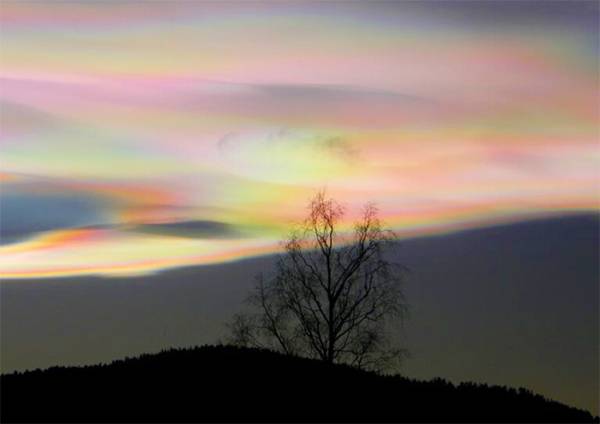
Meanwhile, in Norway, photographer Fredrik Broms documented a series of equally spectacular shots over Kvaløya near Tromsø. The simultaneous appearance of these clouds across multiple countries indicated a widespread region of extreme stratospheric cold, the necessary ingredient for PSC formation. Events of this scale are exceedingly uncommon and often become memorable moments for both scientists and photographers.
Types of polar stratospheric clouds
There are two main types of PSCs, each with different compositions and environmental impacts. Type I PSCs consist of a mixture of water and nitric acid. They tend to produce softer, less dramatic colors and are associated with chemical reactions that can weaken the ozone layer. These clouds provide surfaces on which chlorine-based compounds can react, contributing to ozone depletion in polar regions. Type II PSCs, the ones behind the recent Arctic light show, are made entirely of pure ice crystals. They create much more vivid and photogenic colors and are significantly rarer than Type I clouds. Their rarity makes sightings particularly noteworthy among atmospheric scientists, who use them to understand both stratospheric behavior and climate trends.
Climate change and the future of PSC formation
As global climate patterns shift, scientists believe that polar stratospheric cloud activity may increase. Although global warming warms Earth's surface, it can cause complex changes in upper-atmosphere temperatures. More extreme weather patterns and disruptions in polar air circulation may lead to conditions cold enough to form PSCs more frequently. While this might mean more opportunities to witness these stunning rainbow clouds, it also raises environmental concerns. An increase in Type I PSC formation could accelerate ozone depletion by providing more surfaces for ozone-destroying reactions. This makes monitoring PSC occurrence an important part of understanding the health of the ozone layer and predicting future atmospheric changes.
Why they are often mistaken for auroras
Because nacreous clouds emit bright, shimmering colors across dark skies, they are often confused with aurora borealis. However, the two phenomena come from entirely different processes. Auroras arise when charged solar particles strike Earth’s magnetic field lines, producing dancing curtains of green, red, or purple light. PSCs, on the other hand, owe their colors to sunlight scattering through ice crystals. One key difference is that PSCs appear stationary or slowly shifting, while auroras move rapidly across the sky. Recognizing the difference helps observers better understand the atmospheric dynamics at play during winter nights in the Arctic.
Rainbow clouds are among the rarest and most beautiful atmospheric phenomena on Earth. Their recent appearance across the Arctic provided a spectacular glimpse into the extreme conditions of the stratosphere. While they are breathtaking to behold, they also serve as reminders of the delicate balance within our planet’s atmosphere. Understanding how polar stratospheric clouds form helps us appreciate both their natural beauty and their scientific importance.






Yorumlar
Kalan Karakter: