
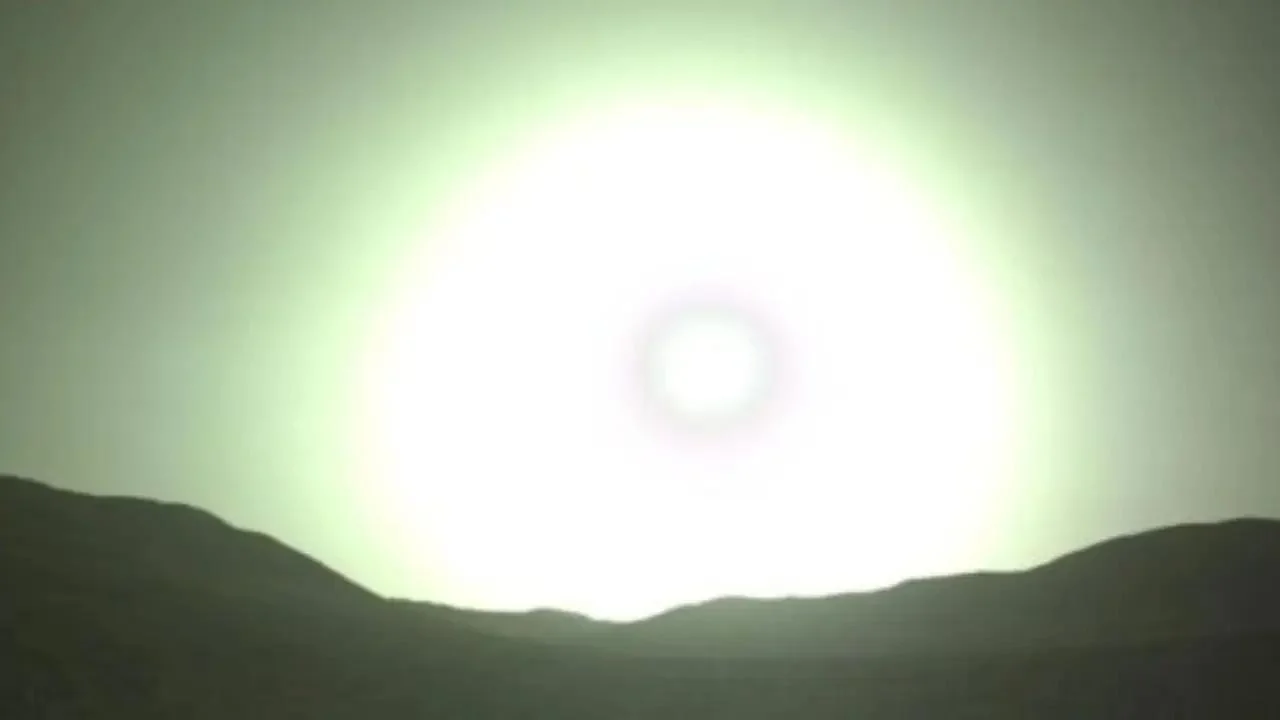
Taken from the dusty plains of Gusev crater, the image stunned scientists and space enthusiasts alike with its surreal colors, distant horizon, and mysterious atmosphere. Unlike sunsets on Earth, the Martian sky glows differently, shaped by fine dust, a thinner atmosphere, and the planet’s greater distance from the Sun.
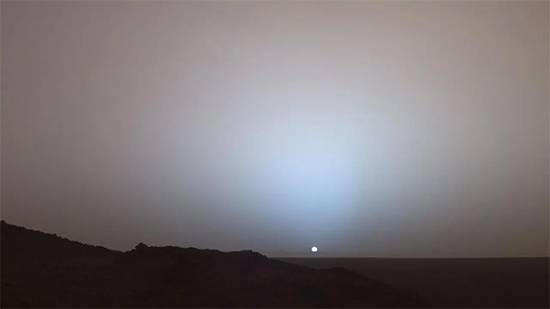
This remarkable photograph is more than just visually striking. It provides valuable scientific data about Mars’ climate, airborne particles, and light scattering. As we explore this iconic image, we uncover not only the Red Planet’s alien beauty but also the science that makes Martian sunsets unlike anything seen on Earth.
A sunset on Mars in 2005
On 19 May 2005, NASA’s Spirit rover paused its geological exploration to look westward across Gusev crater. There, it captured a breathtaking view of the Sun slowly sinking below the Martian horizon. The scene was both familiar and alien. While the setting Sun is a universal experience, the surrounding landscape of rust-colored dust, jagged rocks, and vast emptiness made the moment uniquely Martian.
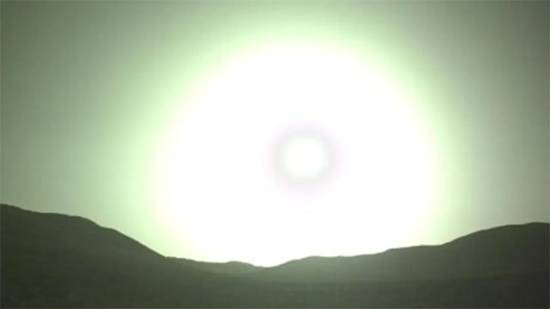
Gusev crater, believed to be an ancient lakebed, provided the perfect vantage point. The distant crater rim, roughly 80 kilometers away, framed the descending Sun. This image quickly became one of NASA’s most iconic Mars photographs, symbolizing humanity’s ability to witness sunsets beyond Earth.
Spirit’s special camera technology
The image was captured using Spirit’s Panoramic Camera, often called the Pancam. This advanced imaging system was designed not only for scenic photography but also for scientific analysis. Equipped with multiple spectral filters, the camera could detect subtle variations in light and color invisible to the human eye.
To create the sunset scene, Spirit assembled a mosaic of images taken through these filters. Scientists later processed the data to approximate what a human observer might see on Mars, while still enhancing certain hues for clarity. This combination of art and science allowed researchers to study atmospheric conditions while sharing a visually compelling image with the public.
A blue glow above the Sun
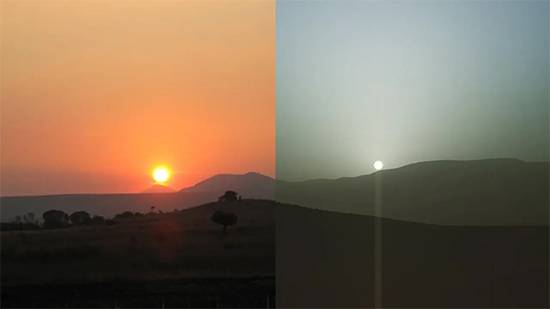
One of the most striking features of the Mars sunset is the bluish halo surrounding the Sun. On Earth, sunsets appear red or orange because our thicker atmosphere scatters shorter blue wavelengths away from our line of sight. Mars, however, behaves differently.
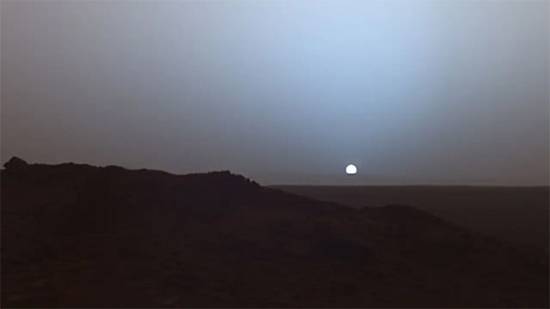
The Martian atmosphere is thin but filled with extremely fine dust particles. These particles scatter red light across the sky while allowing blue light to concentrate near the Sun. The result is a cool blue glow hovering above the setting solar disk. This phenomenon is real and would be visible to astronauts standing on the Martian surface, making Mars sunsets both eerie and mesmerizing.
The Sun looks smaller on Mars
Another unusual aspect of the Spirit rover image is the apparent size of the Sun. Because Mars orbits farther from the Sun than Earth does, the solar disk appears significantly smaller in the Martian sky. On average, the Sun looks about two-thirds the size seen from Earth.
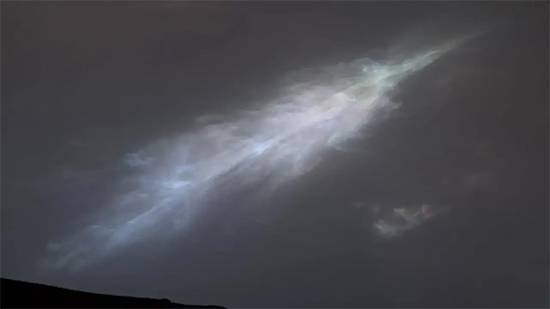
This reduced scale changes the emotional feel of the sunset. Instead of dominating the horizon, the Sun appears distant and subdued, reinforcing the isolation of the Martian landscape. The effect also influences how light spreads across the sky, contributing to the softer, more muted twilight experienced on Mars.
Exploring Gusev crater’s edge
The foreground of the image contains subtle geological details that add depth to the scene. A rocky outcrop known as “Jibsheet” is visible, along with faint rover tracks imprinted in the soil. These tracks serve as a reminder that the photograph was taken not by a human explorer, but by a robotic pioneer millions of kilometers from Earth.
Gusev crater itself holds immense scientific interest. Scientists believe water once flowed into the basin, possibly forming a lake billions of years ago. By capturing sunsets and atmospheric data from this location, Spirit helped researchers understand how dust and climate behave in ancient Martian environments.
Why Martian twilights last longer
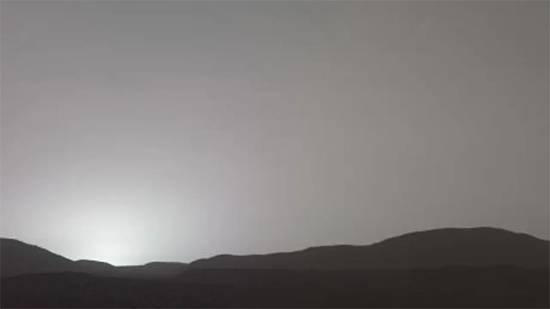
Twilight on Mars is dramatically longer than on Earth. After the Sun dips below the horizon, the sky can remain illuminated for up to two hours. This extended glow occurs because high-altitude dust continues scattering sunlight long after direct rays disappear.
On Earth, similar prolonged twilights sometimes occur after major volcanic eruptions, when ash fills the upper atmosphere. Mars experiences this effect regularly due to its persistent airborne dust. Studying these long twilights helps scientists track seasonal dust cycles and weather patterns across the planet.
Science and beauty in one shot
The 2005 Spirit rover sunset image is more than a cosmic postcard. It provides critical insight into the Martian atmosphere, including dust density, particle size, and cloud presence. By analyzing how light behaves at sunset, researchers refine climate models and improve our understanding of Mars’ environmental history.
At the same time, the photograph resonates on a human level. It reminds us that sunsets, one of Earth’s most cherished daily experiences, also occur on distant worlds. The image bridges science and emotion, turning raw data into a moment of shared wonder.
As NASA continues exploring Mars with newer missions, the Spirit rover’s haunting sunset remains a defining visual milestone. It captures the loneliness, beauty, and scientific intrigue of the Red Planet, inviting us to imagine the day when humans might watch a blue-tinged sunset from the Martian surface with their own eyes.







Yorumlar
Kalan Karakter: