

While past expeditions have delivered haunting photographs and video footage, none have matched the clarity and depth of the newly released three-dimensional images captured during a recent research mission.
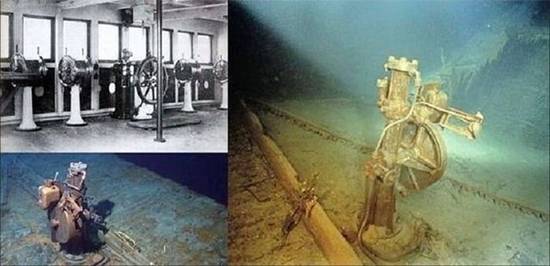
These groundbreaking visuals provide the most detailed representation ever created of the Titanic wreck, allowing experts to study the ship in ways previously impossible. Generated using advanced deep-sea scanning technology, the images reconstruct the wreck site with extraordinary precision. From the bow’s haunting silhouette to scattered debris fields, every detail contributes to a richer understanding of the disaster and its aftermath. This technological milestone not only preserves history but also opens new doors in underwater exploration and maritime archaeology.
Historic breakthrough in deep-sea imaging
The release of these Titanic 3D images marks a turning point in ocean exploration. For decades, researchers relied on submersible photography and limited sonar scans to document the wreck. While valuable, those methods produced fragmented views.
The new expedition utilized state-of-the-art photogrammetry and deep-ocean mapping systems. Thousands of high-resolution images were captured from multiple angles and digitally stitched together to create a full 3D model. This process allows scientists to explore the wreck virtually, rotating perspectives and zooming into minute structural details. It represents the first time such an intricate visual record has been created for an object resting nearly 4,000 meters below sea level.
Location and challenges of reaching the wreck
The Titanic lies approximately 400 miles off the coast of Newfoundland, Canada, in one of the most hostile marine environments on Earth. Extreme depth, freezing temperatures, and crushing water pressure make exploration exceptionally difficult.
Powerful underwater currents and unpredictable North Atlantic storms further complicate missions. Equipment must withstand immense pressure, and dive windows are often short. Because of these dangers, expeditions are costly and rare. The new imaging mission required years of planning, specialized vessels, remotely operated vehicles (ROVs), and highly trained crews.
Unmatched detail of the wreck site
What makes these 3D images revolutionary is the level of detail they reveal. The ship’s bow, still eerily intact, can be seen resting upright on the ocean floor. Railings, anchor chains, and deck structures are visible with stunning clarity.
The stern section, which was torn apart during the sinking, appears as a twisted mass of steel. The debris field surrounding the wreck is mapped in precise detail, showing personal belongings, machinery, and ship fragments scattered across the seabed. This comprehensive perspective helps researchers understand how the ship broke apart and settled after impact with the ocean floor.
Role of RMS Titanic Inc. and legal context
The images were presented during legal proceedings in a Virginia courtroom involving RMS Titanic Inc., the company that holds exclusive salvage rights to the wreck. The organization has led multiple expeditions since the 1980s, recovering artifacts and preserving them for public exhibition. Court discussions often focus on conservation ethics, ownership rights, and the balance between exploration and memorial respect. Presenting the 3D scans in court underscored both the historical value of the wreck and the technological advancements shaping its documentation.
Artifacts and their historical value
Over the years, more than 6,000 artifacts have been recovered from the Titanic site. These include personal items such as jewelry, letters, clothing, and dinnerware, as well as structural components from the ship itself.
While the estimated monetary value of these objects exceeds one million pounds, their cultural and historical significance is far greater. Each artifact offers a tangible connection to passengers and crew who experienced the tragedy. Recovery missions, however, are extraordinarily expensive, often surpassing the financial value of the items retrieved.
Preservation through digital reconstruction
One of the greatest benefits of 3D imaging is preservation without disturbance. Physical salvage can accelerate deterioration if not handled perfectly. Digital documentation, by contrast, leaves the wreck undisturbed.
The 3D model acts as a time capsule, preserving the Titanic’s condition at the moment of scanning. Future researchers can study corrosion patterns, biological growth, and structural decay without repeated deep-sea dives. As the wreck continues to deteriorate due to saltwater corrosion and bacteria, these images will become increasingly valuable historical records.
Advancements in underwater exploration technology
The success of this mission highlights rapid advancements in marine technology. Modern ROVs are equipped with ultra-high-definition cameras, laser scanners, and autonomous navigation systems.
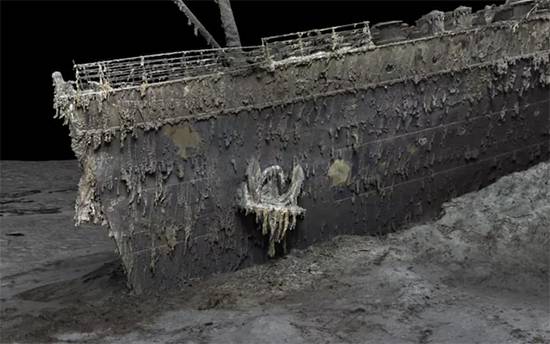
Artificial intelligence assists in image processing, enabling faster and more accurate 3D reconstruction. These innovations are transforming how scientists study shipwrecks, underwater volcanoes, and deep-sea ecosystems. The Titanic project serves as a benchmark for future expeditions seeking to document submerged cultural heritage sites.
Public fascination and cultural legacy
The Titanic remains one of the most studied and mythologized maritime disasters in history. Films, books, and documentaries have kept public interest alive for generations.
These new images reignite global fascination by offering perspectives never seen before. Viewers can witness the wreck not as scattered photos but as a cohesive, immersive site frozen in time. This renewed attention also strengthens calls for responsible preservation, recognizing the wreck as both a historical artifact and a maritime grave site.
Educational and research implications
For historians, engineers, and oceanographers, the 3D scans provide invaluable data. Structural engineers can analyze hull fractures, while archaeologists study artifact distribution.
Educational institutions may use the digital model to create virtual reality experiences, allowing students to explore the Titanic without deep-sea travel. Such applications expand access to history, making the story of the Titanic more tangible and engaging for future generations.
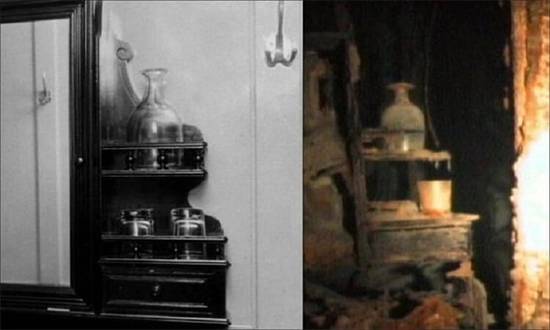
The groundbreaking 3D images of the Titanic wreck represent far more than a technological achievement. They bridge past and present, combining cutting-edge science with one of history’s most poignant tragedies.
By revealing the ship in unprecedented detail, researchers have deepened our understanding of its final moments while preserving its legacy for years to come. As technology continues to evolve, the Titanic’s silent resting place will keep offering new insights, ensuring that its story remains vivid, respectful, and unforgettable.






Yorumlar
Kalan Karakter: