
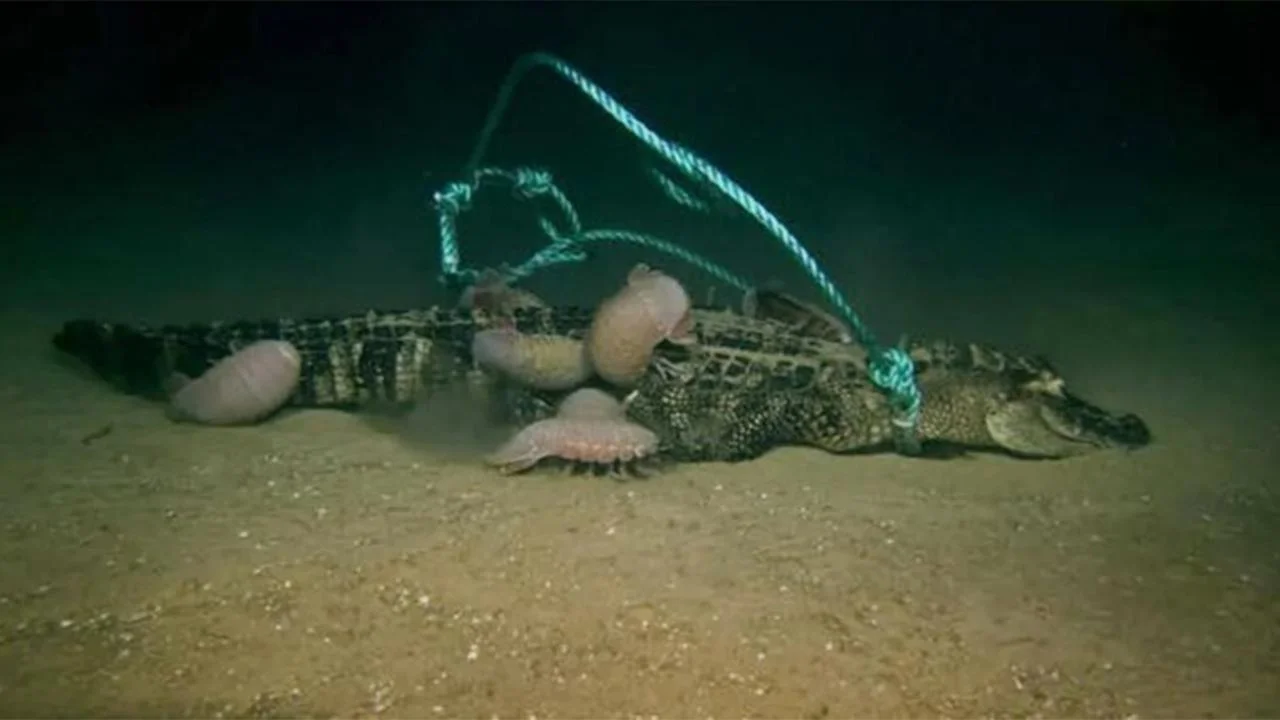
In a bold and unconventional experiment, scientists deliberately lowered dead alligators to the seafloor to observe how deep-sea organisms would respond. What they discovered surprised even seasoned marine biologists. Within days, massive scavengers appeared, and within weeks, the remains revealed a previously unknown bone-eating creature.
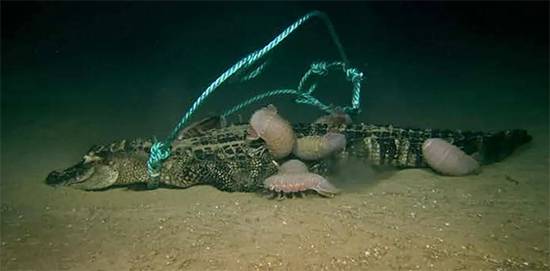
This study not only expanded scientific knowledge of deep-sea scavengers but also demonstrated how adaptable life can be in environments where food is scarce and unpredictable. The findings shed light on how deep-sea ecosystems function and why even the strangest experiments can lead to major discoveries.
Why scientists dropped alligators into the ocean
Researchers from the Louisiana Universities Marine Consortium designed the experiment to better understand how large carcasses affect deep-sea ecosystems. In nature, whales, sharks, and other large animals occasionally sink to the seafloor, creating what scientists call “falls.” These events provide rare but crucial food sources.
Alligators were chosen because they are large, tough-bodied reptiles that rarely enter marine environments naturally, making them an ideal test of how deep-sea organisms handle unfamiliar prey.
What reptile falls reveal about deep-sea ecosystems
Reptile falls are similar to whale falls but far less common. When a large carcass reaches the deep seafloor, it creates a temporary ecosystem that can last months or even years. Scavengers, bacteria, and specialized organisms arrive in stages, each breaking down different parts of the remains. Studying these events helps scientists understand nutrient cycling, species interactions, and survival strategies in the deep ocean.
The extreme conditions of the deep seafloor
At a depth of 2,000 meters, the environment is cold, dark, and under immense pressure. Food is scarce, and most organisms rely on falling organic matter from above. Because resources are limited, deep-sea creatures are highly opportunistic. Any large food source that reaches the bottom becomes a hotspot of activity, attracting scavengers from far distances.
Giant isopods and rapid scavenging
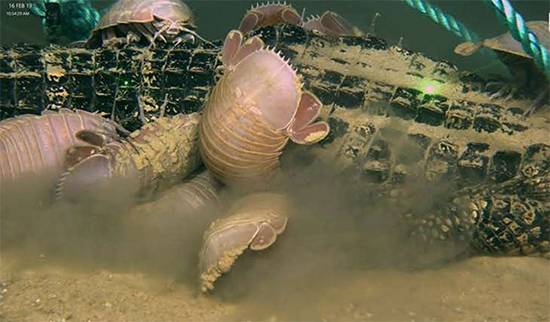
One of the most dramatic discoveries involved giant pink isopods known as Bathynomus giganteus. These foot-long crustaceans are among the deep sea’s most efficient scavengers. When one alligator reached the seafloor, the isopods quickly tore through its thick skin and consumed it from the inside out. Within just 24 hours, the carcass was largely hollowed, showcasing how quickly deep-sea scavengers can exploit a new food source.
Slower decay reveals hidden life
The second alligator experienced a slower breakdown. Over 51 days, scavengers removed all soft tissue, leaving behind exposed bones. This stage of decomposition allowed scientists to observe a more subtle but equally fascinating process. Once the bones were exposed, a new organism appeared, one that feeds not on flesh but on bone itself.
Discovery of a new bone-eating worm
The exposed skeleton revealed a previously unknown species of bone-eating worm belonging to the Osedax genus. These worms are famous for dissolving and consuming bones using symbiotic bacteria.
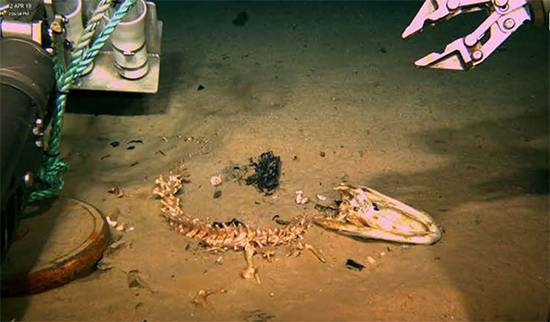
While Osedax species are commonly associated with whale falls, this marked the first recorded appearance of such worms in the Gulf of Mexico. The discovery expanded the known range and adaptability of bone-eating worms.
How bone-eating worms survive without mouths
Osedax worms lack traditional mouths and digestive systems. Instead, they use root-like structures to penetrate bones and rely on bacteria to break down nutrients. This unique adaptation allows them to thrive in environments where other food sources are unavailable. Their presence on the alligator bones confirmed that these worms are not limited to marine mammals.
The mystery of the missing alligator
The third alligator never stayed in place long enough to be studied. When scientists returned after eight days, only the rope and weights remained. The most likely explanation is that a large deep-sea predator, possibly a sixgill shark, dragged the carcass away. This disappearance highlights how unpredictable deep-sea interactions can be.
What this experiment teaches about adaptation
This study demonstrates the incredible adaptability of deep-sea organisms. From giant scavenging isopods to microscopic bacteria and bone-eating worms, life in the deep ocean is ready to exploit any opportunity. Even an animal completely foreign to the marine environment can become part of the deep-sea food web.
Why this research matters
Understanding how deep-sea ecosystems respond to large food falls helps scientists predict how these environments may react to natural events and human impacts. It also emphasizes how much remains undiscovered beneath the ocean’s surface. Each experiment, no matter how unusual, has the potential to reveal new species and new insights into life on Earth.
What comes next for deep-sea research
Scientists plan to continue studying carcass falls using different animals and locations. As technology improves, researchers hope to observe these processes in greater detail. The alligator experiment proves that creative approaches can unlock secrets of the deep ocean, reminding us that even the strangest ideas can lead to extraordinary discoveries.

Yorumlar
Kalan Karakter: