
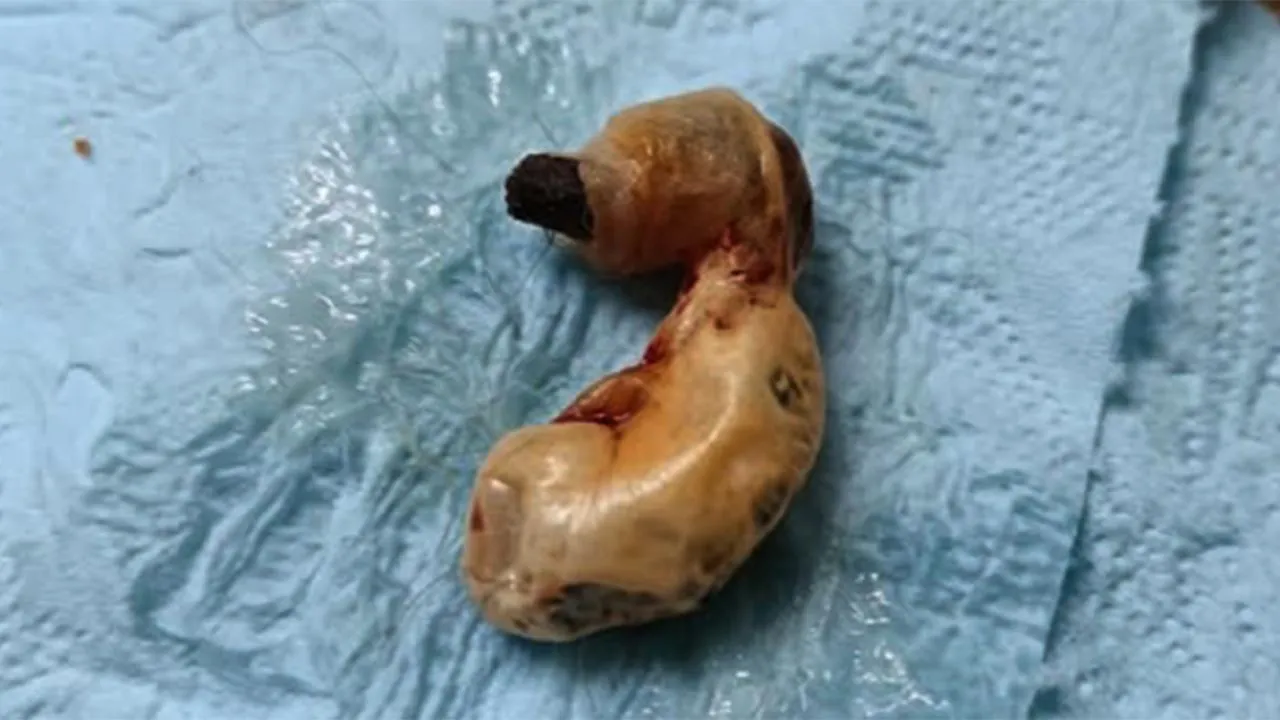
What begins as a quick glance can rapidly evolve into fear, anxiety, and worst-case assumptions. That is exactly what happened when a strange pale object was discovered beneath a bed during routine cleaning. At first glance, it appeared organic, twisted, and disturbingly lifelike. The darkened tip made it look even more suspicious, triggering thoughts of parasites, dead insects, or even a decaying animal hidden inside the room.

The situation quickly became tense as both parent and child stared at the object from a safe distance, unable to identify what they were seeing. The uncertainty made the moment far more frightening than the reality itself. After several nervous minutes and plenty of speculation, the truth finally came to light: the terrifying mystery object was nothing more than a dusty pistachio shell. The experience became both hilarious and memorable, highlighting how easily the human mind transforms harmless objects into frightening possibilities.
How fear changes perception
Fear has a powerful effect on the way people interpret visual information. When an object appears unfamiliar or partially hidden, the brain instinctively searches for danger first. This survival mechanism once helped humans avoid predators and threats in uncertain environments. Even today, the same instinct can make harmless things seem alarming.
In dim lighting, ordinary items often appear distorted. Shadows create strange shapes, dust changes texture, and small details become exaggerated. In this situation, the pistachio shell’s curved shape and darkened tip gave it the appearance of something organic and potentially dangerous. Because it was partially hidden beneath the bed, the imagination filled in the missing details with frightening possibilities.
This reaction is surprisingly common. Many people have mistaken socks for rodents, cables for snakes, or shadows for intruders. The brain naturally prioritizes caution when information is incomplete.
Why objects under the bed feel unsettling
The space beneath a bed has long been associated with mystery and fear. It is dark, difficult to see clearly, and often ignored during everyday cleaning. Because people rarely inspect the area closely, any unfamiliar object discovered there immediately feels suspicious.
Psychologists often explain this discomfort as a fear of uncertainty. Humans tend to feel safer when environments are predictable and visible. Hidden spaces create anxiety because they leave room for imagination to take control.
In this case, the dusty pistachio shell seemed especially disturbing because it looked out of place. It did not immediately resemble food waste. Instead, its texture and shape appeared strangely biological. Combined with the dim lighting and natural nervousness surrounding hidden spaces, the harmless shell became something much more frightening.
How imagination creates miniature horror stories
One of the most fascinating parts of the experience was how quickly imagination escalated the situation. Within seconds, the mind moved from uncertainty to increasingly dramatic theories. Thoughts of parasites, dead animals, insects, and contamination all appeared before the object was even touched.
This happens because the human brain dislikes unanswered questions. When people cannot identify something immediately, the imagination often supplies explanations automatically. Unfortunately, negative possibilities tend to appear faster than logical ones because the brain is designed to detect threats quickly.
The pistachio shell became a perfect example of this psychological process. A forgotten snack transformed into a miniature horror story simply because it looked unusual from the wrong angle. Once the object was pushed into better lighting, reality immediately replaced fear.
The moment of relief and laughter
The emotional shift after discovering the truth was immediate. Tension disappeared almost instantly and was replaced with laughter. Relief laughter is common after moments of fear because the body suddenly releases built-up stress and adrenaline.
Both parent and child had spent several minutes treating the object like a genuine threat. Realizing it was only half of a pistachio shell felt ridiculous and funny at the same time. What made the moment memorable was not the shell itself, but the emotional journey surrounding it.
Experiences like this often become family stories because they combine suspense, embarrassment, and humor in a relatable way. Nearly everyone has experienced a moment where imagination exaggerated reality.
Why this story feels so relatable
Stories involving harmless misunderstandings resonate with people because they reflect everyday human psychology. Most individuals have experienced moments where uncertainty created unnecessary fear. Whether it involves strange noises at night, shadows in a hallway, or mysterious objects under furniture, the emotional pattern is familiar.
This particular story works so well because the object genuinely resembled something unsettling. The dusty pistachio shell had just enough unusual detail to trigger suspicion. Readers can easily imagine themselves reacting the same way.
The experience also highlights how environmental factors influence perception. Darkness, hidden spaces, and isolation all increase anxiety levels. Even intelligent, rational people can temporarily believe something harmless is dangerous when visual information is incomplete.
How small discoveries become unforgettable memories
Ironically, the pistachio shell became memorable not because it was dangerous, but because it revealed something true about human behavior. The incident demonstrated how quickly fear can reshape perception and how easily imagination fills gaps in understanding.
Moments like these often stay vivid for years because they combine strong emotions with sudden relief. The brain remembers emotional experiences more clearly than ordinary events. A simple piece of trash beneath the bed became a lasting family memory because it triggered genuine panic before revealing an unexpectedly harmless explanation.
Even after the laughter faded, the lesson remained surprisingly meaningful. Sometimes the scariest things are not dangerous at all. They only appear frightening because the mind creates stories before the eyes fully understand what is being seen.







Yorumlar
Kalan Karakter: