
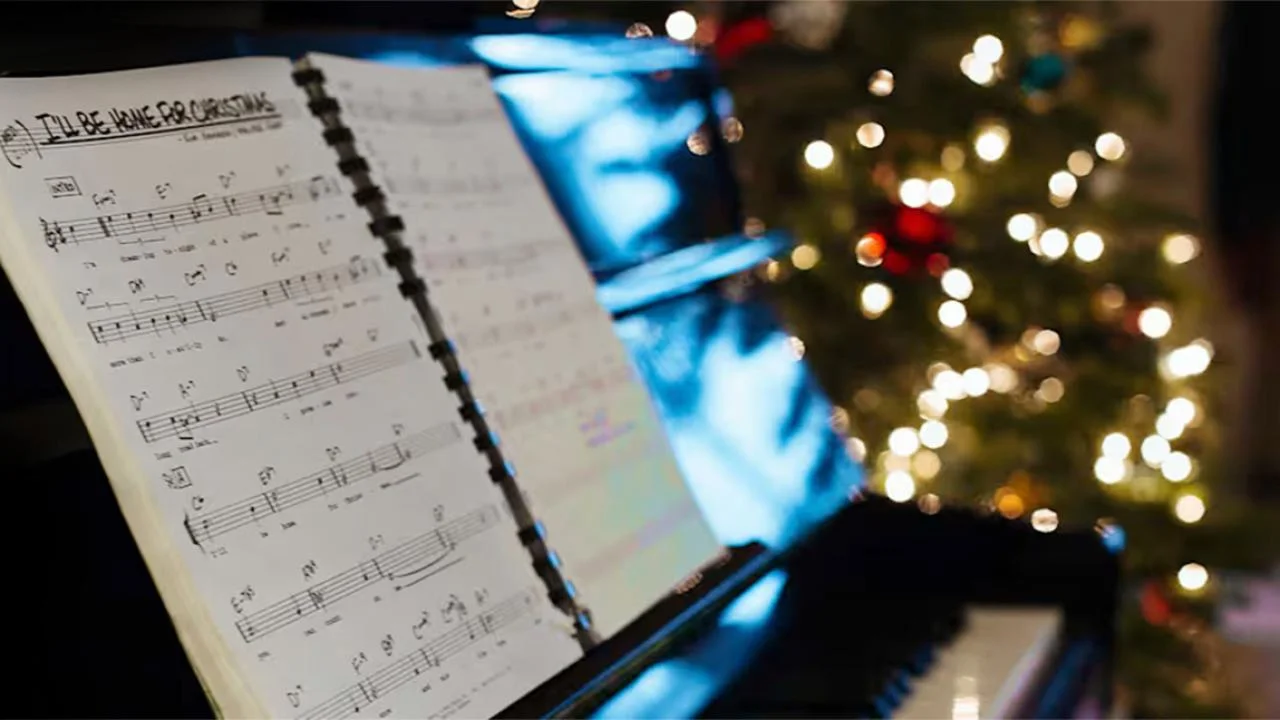
These songs feel timeless, as if they have always existed alongside decorated trees and glowing lights. Yet many beloved Christmas carols and holiday songs have surprisingly specific origins rooted in history, personal stories, and even moments of global conflict. Some began as poems, others as marketing tools, and a few were never intended to be Christmas songs at all. Understanding where these classics came from adds depth and meaning to the music that defines the season. Below are the stories behind six classic Christmas songs that continue to resonate across generations.
Silent Night

Sheet music of Jingle bells. (Credit: Brasil2)
Beyond its peaceful melody, “Silent Night” holds a powerful place in world history. During the Christmas Truce of 1914 in World War I, soldiers on opposing sides reportedly sang carols across the trenches. Letters from soldiers describe hearing “Stille Nacht” sung by German troops, creating a rare moment of shared humanity during wartime. This legacy has helped cement the song as a symbol of peace and hope.
Jingle Bells
Few Christmas songs are as cheerful and instantly recognizable as “Jingle Bells,” yet it was not originally written for Christmas. Composed in 1857 by James Lord Pierpont, the song was first published under the title “One Horse Open Sleigh.” Some historians believe it debuted at a Thanksgiving service rather than a Christmas celebration.
Pierpont wrote both the lyrics and music, drawing inspiration from sleigh races popular in New England during the 19th century. Over time, the song became associated with winter festivities and eventually Christmas itself. Despite the composer’s mixed legacy, including writing Confederate songs during the Civil War, “Jingle Bells” outlived its origins to become a joyful staple of holiday music worldwide.
O Holy Night
“O Holy Night” began as a French poem titled “Minuit, Chrétiens,” written in 1843 by Placide Cappeau. The poem was later set to music by composer Adolphe Adam, and the song gained popularity throughout France before crossing the Atlantic. In 1855, American abolitionist and Unitarian minister John Sullivan Dwight translated the lyrics into English.
Dwight’s translation emphasized themes of justice and freedom, particularly in the line referencing the breaking of chains and the brotherhood of humanity. These words resonated strongly in the years leading up to the American Civil War. The song also made technological history in 1906 when it became one of the first songs ever broadcast on the radio. Today, “O Holy Night” is celebrated for its emotional depth and powerful message.
O Come All Ye Faithful
“O Come All Ye Faithful” traces its roots to the Latin hymn “Adeste Fideles.” The song is believed to have been written in the mid-18th century by John Francis Wade, an English musician living in France. Originally sung in Latin, the hymn spread throughout Europe before being translated into English.
Like “Silent Night,” this carol played a role in the Christmas Truce of 1914. When British soldiers sang the English version, German soldiers reportedly joined in by singing the original Latin lyrics. This shared musical moment highlighted the unifying power of Christmas carols, even in the midst of war.
Rudolph the Red-Nosed Reindeer
Unlike traditional carols, “Rudolph the Red-Nosed Reindeer” began as a commercial project. In 1939, department store Montgomery Ward distributed a free Christmas booklet featuring a story written by catalog copywriter Robert L. May. The character of Rudolph was inspired by May’s own childhood experiences of feeling like an outsider.
Years later, May regained the rights to the story and collaborated with his brother-in-law to turn it into a song. Recorded by Gene Autry in 1949, the song became an instant hit. Rudolph’s story of perseverance and acceptance resonated with audiences, and the character became a permanent part of Christmas culture, further popularized by a television special in 1964.
White Christmas
“White Christmas,” written by Irving Berlin, is one of the best-selling songs of all time. Berlin composed it between 1937 and 1939, originally intending it for a Broadway revue that never materialized. The song eventually found its home in the 1942 film Holiday Inn, performed by Bing Crosby.
The song debuted on Christmas Day in 1941 during a radio broadcast, just weeks after the attack on Pearl Harbor. Its nostalgic lyrics struck a chord with listeners longing for peace and familiarity during wartime. When Crosby later performed “White Christmas” for American troops overseas, it became their most requested song. Its enduring popularity lies in its ability to evoke longing, comfort, and the emotional heart of the holiday season.
These six classic Christmas songs remind us that holiday music is more than background noise. Each melody carries stories of creativity, struggle, hope, and connection, making the season’s soundtrack richer with every note.









Yorumlar
Kalan Karakter: